Usage
Game mechanics
The game board consists of hexagonal tiles with different features with different movement costs. A player wins the game if they reach an ending hex first, or before the player who first reached an ending hex would take their next turn.
Movement is enabled by playing cards, which can have various resources or special effects. Additional powerful cards can be purchased from a shop that is common between all players.
A differentiating feature from most adversarial game environments is that the step order is not pre-determined as a round-robin. Due to the action space complexity, a single player turn consists of a sequence of steps, each of which corresponds to one of:
playing a card normally
playing the special action of a card
movement to an adjacent hex
removing a card from the players hand
adding a card to the player deck from the shop
A player turn starts in the movement phase, in which cards can be played in order to take advantage of their resources to move on the map. When an empty action is taken, the turn moves to the shop phase, where played cards add coins to the player. Then, given enough coins are accumulated, the player can buy a card from the shop, which ends the turn. Some cards have special actions which overrule the phase system until they have been completed. Such actions can be a free movement, removing cards from the hand, and adding a card from the shop for free.
The observation space of the environment consists of a shared component and data individual to each player. The shared observation contains an encoding of the Map, where for each hex the following information is stored:
Currently occupying player
machete requirement
paddle requirement
coin requirement
discard requirement
remove requirement
is finish hex
The currently occupying player is preprocessed such that the hex of the currently selected player has value 1, the player next to take their turn value 2, etc. Unoccupied hexes have value 0. The various requirements encode how many resources are required to move onto the hex. Discard requirements require the player to discard n cards from their active cards and remove requirements likewise remove the cards from play completely. The map observation consists of a 48x48 array of the encoded hex data.
The shared observation also contains the shop, which stores simply how many of each card of the shop are available to buy.
A single unsigned value stores the active turn phase. An array is used to store the current resources of the active player.
Player specific observations store the information of the player’s cards. They are split to the drawpile, hand, active, played and discard arrays. Each of these store the frequencies of each card type currently in that state. This gives the benefit of order invariance over an actual queue/list of cards.
The player observation also contains an action mask, signaling the set of valid actions that player can take at this time, based on the cards in hand, current resources, possibly active special actions and their surrounding hexes.
The environment mechanics are similar to the “The Quest for El Dorado” board-game. No external assets are used, and no UI is implemented for “playing” the City of Gold game outside Python scripting or interfacing with C++ code. This code is intended as a tool to research and validate reinforcement learning methods and models in a complex, procedurally generated environment with interactions between multiple players. As game mechanics alone do not fall under copyright [1], this repository can be freely distributed and is licensed under Apache 2.0.
Installation
A pypi package of the environment is a work in progress. Currently you can install the environment by cloning the repo and building the source code using the included pyproject.toml configuration.
git clone git@github.com:aapo-kossi/city-of-gold.git
pip install ./city-of-gold
Running the environment
The environment exposes multiple interfaces for running the game. For performance considerations and due to the uniqueness of the observation and action spaces, the interface does not conform to any existing framework like gymnasium or pettingzoo, though the paradigm used by pettingzoo environments is an inspiration for this environment, as this project originated as a python implementation that used the pettingzoo api.
The main usage pattern of the environment follows the example below:
import multiprocessing as mp

# Running environments in parallel
n_envs = 16
seed = 0
workers = mp.cpu_count() - 1
steps = 1_000

env_cls = city_of_gold.get_vec_env(n_envs)
sampler_cls = city_of_gold.get_vec_sampler(n_envs)
envs = env_cls()
samplers = sampler_cls(seed)
runner_cls = city_of_gold.get_runner(n_envs)
runner = runner_cls(envs, samplers, workers)

envs.reset(seed, 4, 3, city_of_gold.Difficulty.EASY, 100000, False)

# get reference to persistent actions vector, updated internally
actions = samplers.get_actions()

# get references to internal data structures
next_agents = np.expand_dims(envs.agent_selection, 1)
next_obs = envs.observations
am = next_obs["player_data"]["action_mask"]
player_masks = envs.selected_action_masks
current_rewards = envs.rewards
current_dones = envs.dones
current_infos = envs.infos

start = time.time()
for i in range(steps):

    # update actions array using action_masks
    runner.sample()

    # step the environments with the sampled actions, block until ready!
    runner.step_sync()

    # print info from finished episodes
    for i in np.nonzero(current_dones)[0]:
        print(current_infos[i])
Primitive rendering of the game map can be enabled for a single environment with
the render flag in the city_of_gold.cog_env() constructor. Then,
the current environment state can be displayed on screen by calling the
city_of_gold.cog_env.render() method. Below is an example render
of a game state.
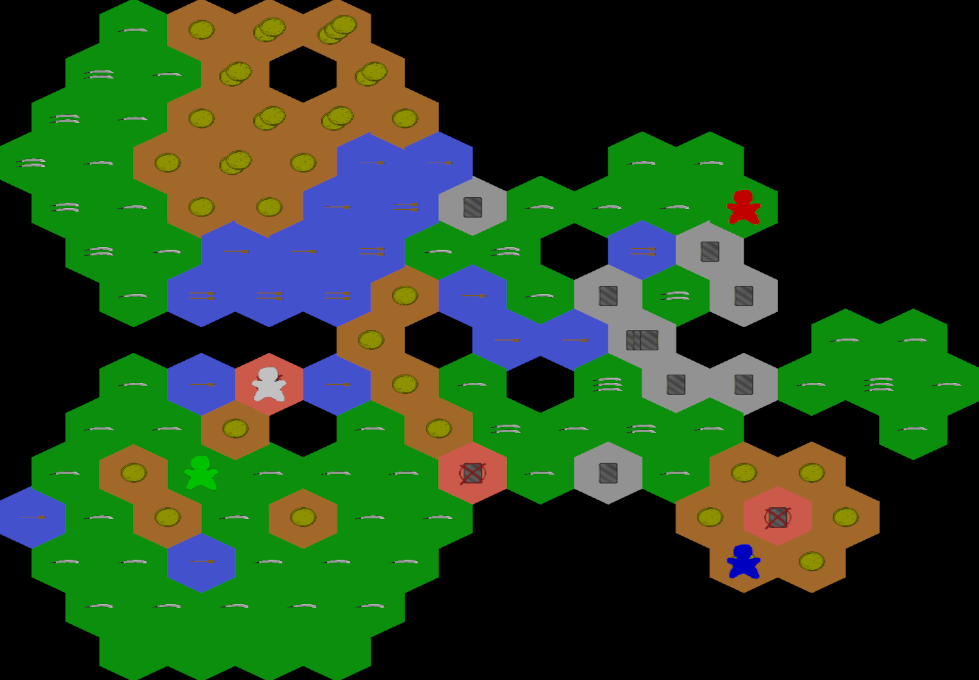
The built-in action sampler is a simple uniform random agent, sampling from all possible valid actions. Full reference documentation of the module interface is a work in progress.
Not respecting the action mask of the current player when stepping the environment results in undefined behaviour. It is the user’s responsibility to prevent this in their application. This is a choice based on performance considerations, given that an RL algorithm learning the environment needs to mask its policy distribution using the action mask, making verification inside the environment unnecessary.